1. What are Quarks?
Quarks are elementary particles that combine to form hadrons such as protons, neutrons, and mesons. They are not observed freely in nature due to quark confinement.
Key Point:
Quarks are fundamental particles of the Standard Model.
2. Types (Flavours) of Quarks
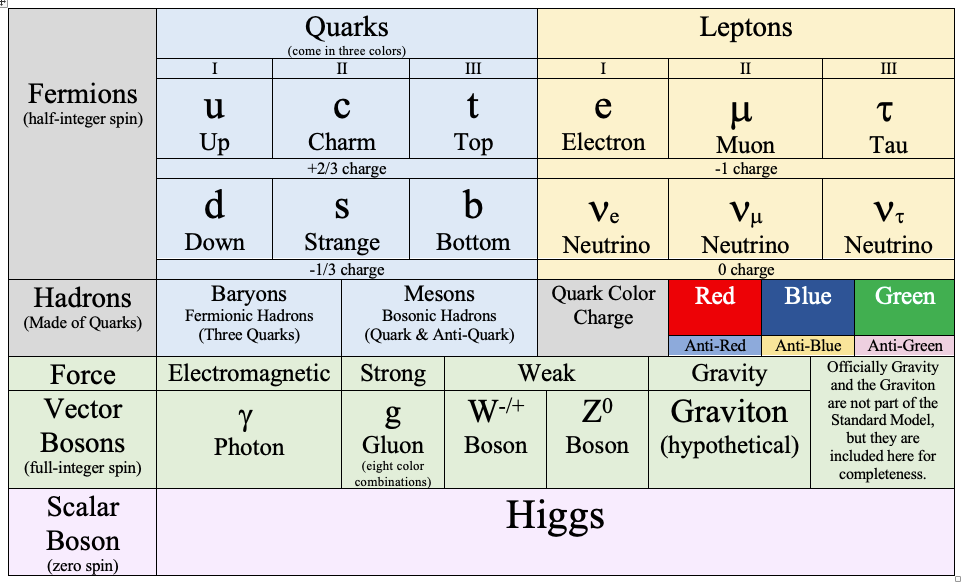
There are six types of quarks, called flavours, arranged in three generations:
| Generation | Quark | Symbol | Charge |
|---|---|---|---|
| 1st | Up | u | +2/3 e |
| Down | d | −1/3 e | |
| 2nd | Charm | c | +2/3 e |
| Strange | s | −1/3 e | |
| 3rd | Top | t | +2/3 e |
| Bottom | b | −1/3 e |
3. Properties of Quarks
| Flavour | Symbol | Color | Charge (e) | Mass (MeV/c²) | Charm (C) | Beauty (B′) | Strangeness (S) | Spin | Baryon No. (B) |
|---|---|---|---|---|---|---|---|---|---|
| Up | u | R, G, B | +2/3 | ~2.2 | 0 | 0 | 0 | 1/2 | 1/3 |
| Down | d | R, G, B | −1/3 | ~4.7 | 0 | 0 | 0 | 1/2 | 1/3 |
| Charm | c | R, G, B | +2/3 | ~1270 | +1 | 0 | 0 | 1/2 | 1/3 |
| Strange | s | R, G, B | −1/3 | ~96 | 0 | 0 | −1 | 1/2 | 1/3 |
| Top | t | R, G, B | +2/3 | ~173000 | 0 | 0 | 0 | 1/2 | 1/3 |
| Bottom (Beauty) | b | R, G, B | −1/3 | ~4180 | 0 | −1 | 0 | 1/2 | 1/3 |
Note: All quarks carry one of three color charges (Red, Green, Blue) and obey color confinement.
Color charge is unrelated to visual color; it is a property of
strong interaction.
4. Quark Confinement
Isolated quarks are never observed. They are always found in color-neutral combinations.
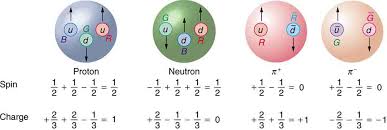
- Baryons → three quarks (qqq)
- Mesons → quark–antiquark pair (q q̄)
5. Quarks in Hadrons
| Hadron | Quark Composition | Charge |
|---|---|---|
| Proton | uud | +1 |
| Neutron | udd | 0 |
| π⁺ | u d̄ | +1 |
| K⁻ | s ū | −1 |
6. Interactions of Quarks
| Interaction | Participate? |
|---|---|
| Gravitational | Yes |
| Electromagnetic | Yes |
| Weak | Yes |
| Strong | Yes |
7. Importance of Quarks
- Explain the internal structure of hadrons
- Foundation of Quantum Chromodynamics (QCD)
- Account for hadron properties and classification
- Essential part of the Standard Model
8. Quark Compositon
9. Summary
✔ Quarks are fundamental particles
✔ Exist in six flavours
✔ Carry fractional charge and color charge
✔ Combine to form hadrons
✔ Never exist freely in nature